CITY ROOMS
-
The Factory and The City
Industrial Development in Singapore
-
In Collaboration with Yang Huang, Yao Bo

This project rests on two core ambitions: reimagining the city as a conscious project of human creation, and developing new approaches to urban development in response to Singapore's industrial growth. The first ambition views city-making as an intersection of cultural expression, political will, and aesthetic vision. The second treats urbanization as a strategic endeavor, orchestrated through the careful integration of architecture, landscape, and infrastructure.
I. The Beginning of The Story
The story opens with a status quo in Singapore - land shortages, industrial development, and a growing population.
Within this context, a new 55-hectare mixed-use industrial zone is taking shape, strategically positioned between Malaysia's border and Republic Polytechnic, with direct access to the Woodlands North MRT Station. In response to these spatial constraints, Jurong Town Corporation (JTC), Singapore's statutory board responsible for industrial land planning, has adopted a dual strategy: intensifying development of clean technology industries within Singapore while relocating more polluting, labor-intensive operations to the Singapore-Malaysia border region.
II. Research
(1) Recuperation: The City As A Project
Industry 4.0 has catalyzed the Maker Movement, empowering individuals to control the entire product lifecycle—from funding and design to manufacturing, distribution, marketing, and sales. This democratization of production emphasizes collaborative knowledge-sharing and technological exchange, transforming people from passive consumers into active creators and community contributors. Unlike traditional factories, makerspaces are distinguished by their central living rooms—communal spaces that facilitate social interaction and knowledge exchange. These social spaces reflect the collaborative nature of the maker economy, where sharing ideas is as crucial as creating products.
Therefore, the makers' economy is driving a fundamental transformation of traditional factory spaces. Rather than remaining isolated on the urban periphery, industrial and manufacturing facilities are being reimagined as integral parts of the city core, with social interaction at their heart. This shift raises a critical question for Singapore: What forms of public space can best foster the social connections essential to this new makers' culture? To address this, we must first examine Singapore's existing typology of public spaces.

Esplanades and Parks
Among Singapore's public spaces, esplanades and parks represent the first major typology. The Padang exemplifies this form: originally designed as a defensive buffer zone to protect the urban core from cannon fire, it has evolved to serve ceremonial and recreational purposes. However, its open design proves problematic in Singapore's climate—the vast, unshaded field often stands empty, as its direct exposure to the tropical sun makes it inhospitable for daily use.

The "Five-foot Way" of Shophouse
The five-foot way of Singapore's traditional shophouse represents the second significant public space typology. These shophouses, which dominated Singapore's historic downtown, blend Chinese Lilong house design with British colonial grid planning. Despite their narrow dimensions, these covered walkways masterfully define the street edge while creating a transitional space between public thoroughfares and private dwellings.

Transportation Driven Public Space
The third typology emerges from Singapore's transportation infrastructure, particularly its MRT system. While the network's stations, entrances, and exits have created new forms of public space, these areas primarily serve as movement corridors rather than destinations for social gathering and respite.

Transportation Driven Public Space
The fourth typology reflects Singapore's shift toward commercial-driven public spaces. Shopping malls and their vast atria have supplanted the traditional network of streets and alleyways, effectively interiorizing public life. While this transformation offers welcome shelter from Singapore's tropical climate, these commercial spaces primarily cater to consumption rather than genuine social interaction, limiting their potential as true community spaces.
(2) Recuperation: The City As A Project
The City Room
The limitations of Singapore's existing public space typologies prompt us to reconsider what constitutes effective social space at an urban scale. Our project explores Fumihiko Maki's concept of the "city room" as a promising model for Singapore's public realm. This approach offers two key advantages: it can accommodate diverse programs and functions within a unified space while providing environmental mediation crucial for Singapore's hot and humid tropical climate.

The City Room, Fumihiko Maki
The city room exemplifies Maki's theory of Group Form, operating at two distinct scales: as an interior space and as a larger urban composition. At the smaller scale, it functions as a contained room; at the larger scale, it manifests as a collection of spaces that, when organized according to specific principles, creates one of Maki's collective forms.
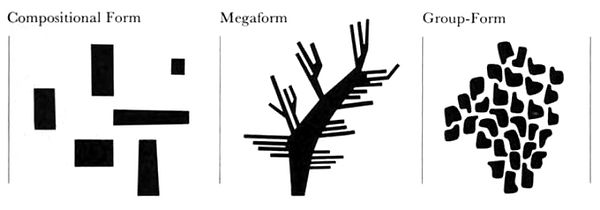
Group Form, Fumihiko Maki
Typology Analysis
Two precedents offer the possibility for construction and densification of the city room in Singapore.
In terms of the enclosure of large space in the city room, ZKM utilizes two vertical concrete slabs connected by vierendeel truss to provide big structure-free spaces in the center. The city room could take advantage of ZKM's structure system to accommodate multiple and sharing space in the center hall. Plus, the vertical hollow structures will also encapsulate circulation and utility spaces.

ZKM, OMA
City Room
Moreover, due to the shortage of land, numerous factories in Singapore are multi-floored in order to intensify the use of land. We also can see a number of cases that the stacking of different programs in one building in Singapore. Therefore, it raises the question of how we create the programmatic switch.
The School of the Arts design by WOHA is another good case to look at. The middle structural layer of this project acts as a programmatic switcher between the school on the upper part and the public facilities underneath. In our proposal, the factory layer in the middle can be a transferring plate that allows the programs above and below to be fundamentally different.

School of the Arts, WOHA
City Room
III. Proposal
(1) Factory As The Framework of The City Room

Factory As The Framework of The City Room
Vertically, the factory layer in the middle acts as the transfer plate between the city rooms below and the housing above. Since the stacking of programs in Singapore is inevitable and necessary due to its intensive land use, creating the second ground through a transferring plate becomes increasingly convincing.
The city room on the ground level encapsulated by maker space and the factory above. Different from Maki's city room which is merely retail-driven, our proposed city room is the integration of different urban programs with makerspace. The city room provides large sheltered interiorized public space for different urban activities. Meanwhile, it is like an urban living room that people get together to share and communicate. The civic activities and the whole process of the maker industry such as design, training, manufacture, and selling take place simultaneously in the city rooms and inspire each other through the vivid interaction.
(2) Site Plan
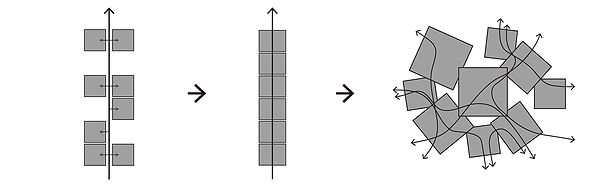
As mentioned above, with the extensive maker-space revolution, factory or the maker space nowadays has the potential to be integrated into city life with social spaces and diverse programs, thus triggering new manufacturing mode and a new way of life. So our project is a string of city rooms bounded by the colonnaded shop house.
It is not a spine moving into rooms, neither is it a linear sequence of rooms, but provides multiple entrances and exits according to the urban context into the various city rooms. Various city rooms connected with each other form the collective public space for the whole city. This continuous experience from room to room also responds to the tropical climate in Singapore.

Site Plan & Axonometric View
City Room As The Library And Media-related Innovation Center
The city room makes the open library with grand walls of bookshelves in it possible. People could read wherever they like to: in the collective reading space, in the leisure space around, or even reading in the staircases that are all the way to the top of the bookshelf. At the same time, People can easily participate in the media-press-related makers’ industry. The training studio like reading, publication, and bookmaking are open to the citizens, where ideas and knowledge can be shared, and people can even try to DIY a book in these maker spaces.

City Room As The Library And Media-Related Innovation Center
City Room As The Fitness Center And Sports-related Makers' Hub
Moreover, a sheltered city room is an ideal place for indoor and outdoor sports. People can swim, run, play balls, and do other exercises regardless of the weather in the city room. At the same time, the city room of the fitness-related industry is not only a lab that people invent, test, upgrade, and customize fitness equipment, but also a hub of fans tethering together for sports events.

City Room As The Fitness Center And Sport-related Makers' Hub
City Room As The Fabrication Lab
In the city room of fab lab, participatory lectures and exhibitions of the newest high tech of manufacturing are open to citizens. And the fab lab city room is a more versatile space as an incubator of startups from different fields. One can always visit the lab to see the operation of the robotic producing and discuss with technicians and experts to materialize their concepts of new products.

City Room As The Fabrication Lab
City Room As The Central Plaza
The city room in the center serves as a central plaza for multiple purposes. A series of big events can accommodate in the central plaza due to its tremendous open space. For instance, it could be the exhibition hall of the spacecraft of the newest research and development. Also, it can be converted into a live concert hall with the capacity of thousands of audiences.

City Room As Central Plaza
Structural Transferring Place: The Factory
As mentioned, the factory layer in the middle acts as the transfer plate between the city rooms below and the housing above. It’s the space that accommodates the mass production robotic manufacturing streamlines as well as research institutes with space for sharing and communicating.

Structural Transferring Plate: The Factory
The Second Ground Above The Factory: Housing & Garden
Different types of housing buildings and various types of units can be provided on the second ground above the factory level. Small rental units are provided above the station city room which response to the huge flow in the adjacent station and their temporary needs for accommodation. Also, near the educational institutes, there is a provision of student housing with shared common space, in which the enlarged corridor becomes the platform for interaction that is buffered by the landscape. The others are medium and large units for families and people who work and live here, which also accommodate the extended corridors that act as social spaces and the response to the tropical climate as well.
In a nutshell, by using Factory and makerspace as the framework and organizer, the city rooms are introduced as the prototype to integrate social space that accommodates various programs and city life with makerspace and factory, through which urban synergy is achieved.

The Second Ground Above The Factory: Housing & Garden


